
How to Choose a Violin or String Instrument
Sizing, outfits, setup and maintenance - a Footscray strings specialist helps parents, adult beginners and teachers choose a violin, viola or cello that aids progress.
Whether you're a parent kitting out a school-age beginner, an adult finally starting lessons, or a teacher steering families, the same things decide whether a string instrument helps or hinders: the right size, an honest setup, and a few habits that keep it playable. Get those wrong and a keen kid quietly gives up; get them right and they fall in love with the sound.
We've sold and played violins, violas and cellos on the Footscray floor since 1997, and we string and set up these instruments every week. This guide is the advice we give over the counter - plain, specific, and aimed at getting you to the right instrument first time.
Sizing is everything (1/16 to 4/4)
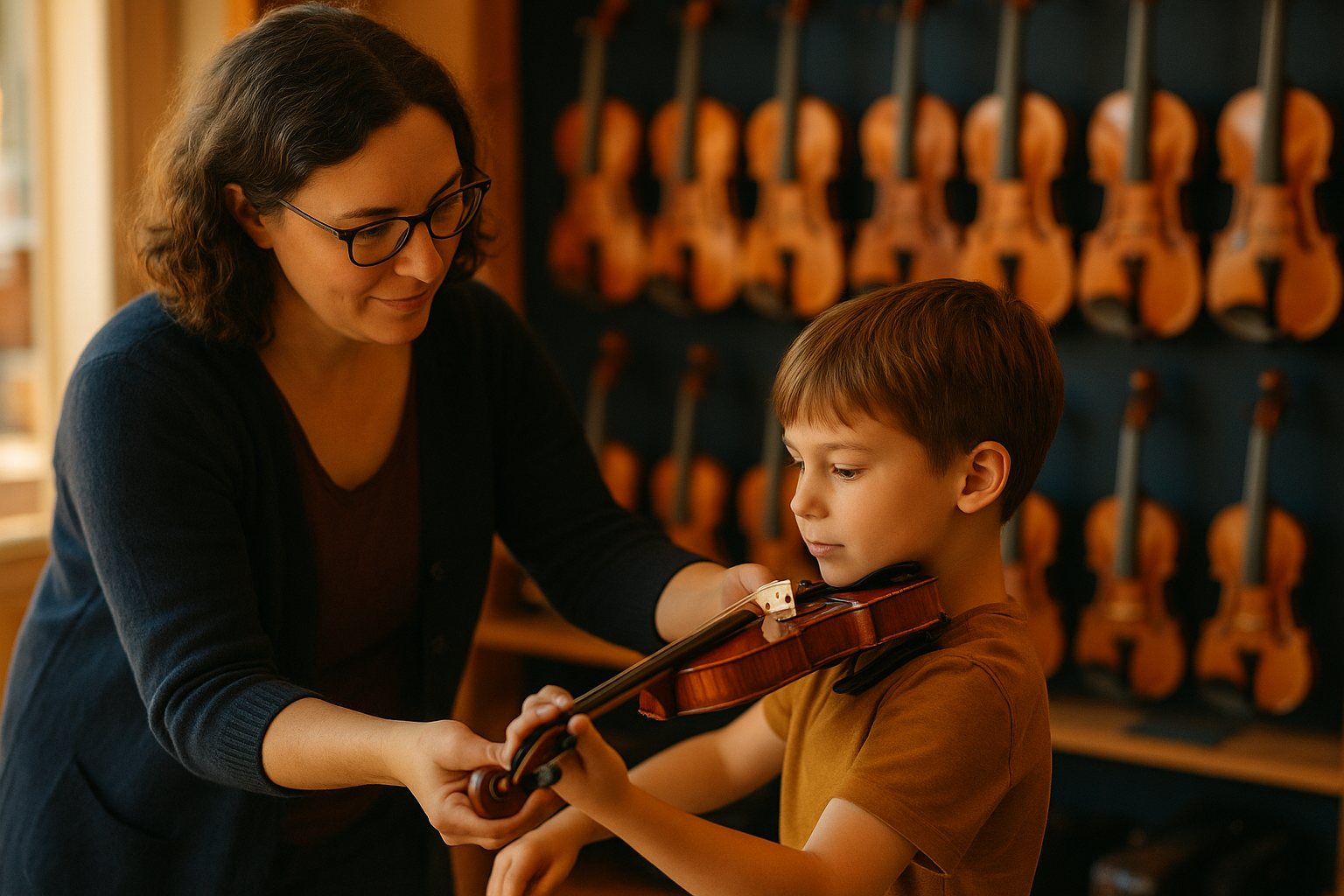
Nothing matters more than size. A violin that's too big strains a child's left hand and shoulder, makes the spacing impossible to play in tune, and turns practice into a fight. The right size lets the hand reach the scroll comfortably and the bow track straight.
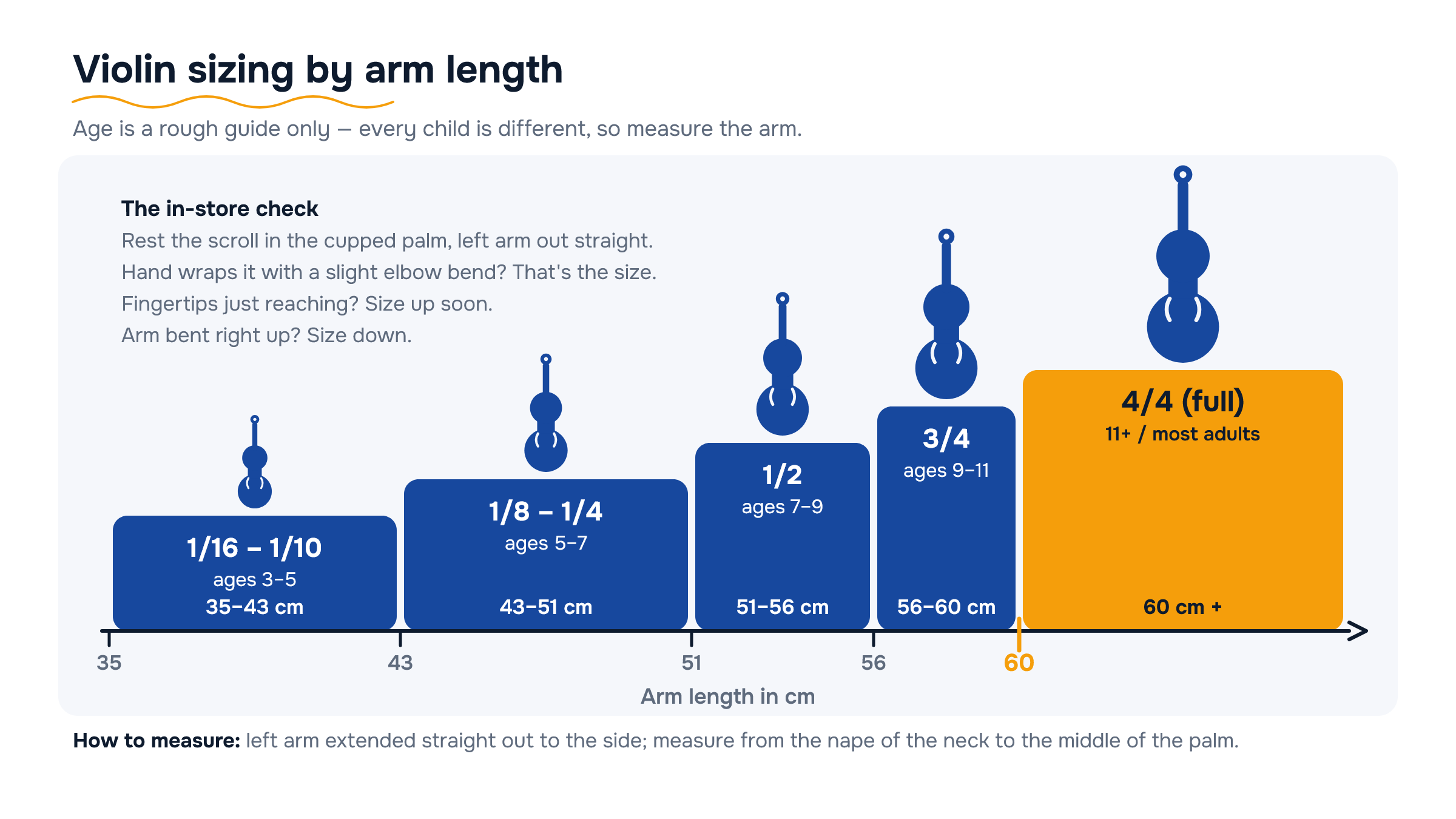
Violins run from tiny 1/16 up to full 4/4. The classic check: have the player stand, extend the left arm out to the side, and rest the scroll (the very end) in the cupped palm. If the hand wraps the scroll comfortably with a slight elbow bend, that's the size. Fingertips just reaching means size up soon; arm bent right up means size down.
As a rough age guide only - every child is different, so measure the arm:
- 1/16 - 1/10: ages 3-5
- 1/8 - 1/4: ages 5-7
- 1/2: ages 7-9
- 3/4: ages 9-11
- 4/4 (full): roughly 11+ / most adults
Violas are measured in inches across the body (commonly 12 to 16 inch) rather than fractions, and cellos follow the same 1/4-to-4/4 fractional system as violins. Browse our orchestral string instruments by size, and if you're unsure, measure the arm and call us - we size kids over the phone every week.
Outfit vs instrument-only: what you actually need
A beginner needs more than a violin. You need a bow, a case, rosin and (for violin/viola) a shoulder and chin rest setup. Buying these piecemeal usually costs more and risks mismatched sizes.
That's why most beginners should buy an outfit - the instrument, a matched bow, a hard case and a cake of rosin bundled together, sized as a set. It's the simplest, best-value way to get a school starter playing from day one.
- Bow: matched to the instrument size; on starter outfits it's usually a serviceable composite or basic wood bow.
- Case: a hard case protects the instrument in a school bag - non-negotiable for kids.
- Rosin: a fresh cake; without it the bow won't grip the string and won't make a sound.
- Rests: a shoulder rest and chin rest sized to the player make holding comfortable and posture correct.
Buy instrument-only when you're upgrading and already own a good bow and case, or when a teacher has specced a particular bow. Otherwise, start with an outfit and add a better bow or shoulder rest later as the player grows.
Why a set-up instrument beats an online toy
This is the single biggest trap. The cheapest violins online arrive unplayable: pegs that won't hold tune, a bridge that's the wrong shape or not even fitted, a nut cut too high, and dead, badly-wound strings. A child given one of these can practise for an hour and never play in tune, because the instrument literally can't.
A real setup is what you're paying a music shop for. Before a string instrument is fit to play, someone has to fit and shape the bridge to the right curve and height, dress the pegs so they turn smoothly and hold, cut the nut and check the fingerboard, and fit decent strings. We do this work so the instrument plays in tune and stays in tune.
The practical test: a set-up instrument tunes easily, holds pitch through a practice session, and is comfortable to press down. A no-name online special often needs that setup work done anyway - which can cost as much as the violin - so the bargain disappears. Start with a properly set-up violin from people who play them, and your beginner gets a fair shot.
Violin, viola or cello - which to choose
Most beginners, especially young children, start on violin. It's the smallest, comes in the widest range of sizes (down to 1/16), and there's the most beginner repertoire and teaching for it. It's the default school-program instrument.
The viola is a little larger, tuned a fifth lower, with a warmer, deeper voice and read in the alto clef. It suits players with slightly longer arms or anyone drawn to the mellower middle of the section - and good violists are always in demand in ensembles. Sizes are quoted in inches across the body.
The cello is played seated with an endpin on the floor, so the player's height drives the size more than arm length. Many kids who can't get comfortable holding a violin take to cello immediately because the posture is natural. It's a bigger spend and needs a stand and floor space at home, but the sound is gorgeous and it's very rewarding.
School playing a specific part? Let the program guide you. Otherwise, browse viola and cello, or come in and let a beginner try all three - the instrument they're drawn to is the one they'll practise.
Maintenance basics that keep it playable
String instruments are simple to look after, and a few habits prevent most problems. None of this takes more than a minute a day.
- Rosin the bow: a few strokes before each session so the hair grips. New bows need more to get going; after that, top up when the tone goes thin. Don't over-rosin - it makes a gritty, dusty sound.
- Wipe the strings and body: after playing, run a soft dry cloth down the strings and under the bridge to lift off rosin dust. Left to build up, that dust bakes onto the varnish and dulls the strings.
- Loosen the bow: always slacken the bow hair when you pack up, or you'll warp the stick over time.
- Humidity: wood hates extremes. Keep it out of car boots, away from heaters and direct sun. Melbourne's swings are usually fine, but a dry winter room can open seams - a case humidifier helps.
- Strings wear out: beginner strings last roughly 6-12 months of regular play before they go dull and false. Fresh strings transform a tired instrument.
Stock up on rosin, a case or fresh violin strings any time, or pop into the Footscray showroom and we'll show you the wipe-down and rosin routine in two minutes - far easier shown than written.
When to upgrade
Two things trigger an upgrade: outgrowing the size, or outgrowing the instrument's tone. For kids, size comes first - re-measure the arm every six to twelve months during growth spurts and move up a fraction when the scroll stops sitting comfortably in the palm. A too-small instrument quietly holds technique back.
The second trigger is when a committed player has gone as far as a starter instrument will take them. Signs: they're playing with real control but the tone stays thin or harsh no matter how they bow, they're frustrated by the response, or a teacher suggests it. A step up in instrument - and often a better bow - can be the bigger improvement, since the bow does so much of the work.
Many families upgrade in stages: keep the outfit, add a quality bow first, then move to a better instrument when the player hits full 4/4. We're happy to set you up at any step and talk honestly about whether it's worth it yet. Call us on 03 4151 5751 or visit the Footscray showroom to play a few side by side - trying them in person is the only way to hear the difference.
What your budget gets you
Under $300
Young school beginners and cautious first-timers testing the waters.
A properly set-up student violin or viola outfit - instrument, bow, case and rosin in one box. Check it's been set up by the shop, not a bare online special; that's the difference between playable and unplayable.
Shop Orchestral String Instruments under $300 →$300-$700
Committed beginners and improving students past the first year.
Better tonewoods, ebony fittings, a more responsive bow and nicer strings - noticeably easier to play in tune and more pleasant to listen to. The sweet spot for a child who's clearly sticking with it.
Shop Violin $300–$700 →$700-$1,500
Intermediate players, exam candidates and keen adult learners.
Solid carved tops, hand-finished setup and warmer projection that carries in an ensemble. Often worth pairing with a better bow, which lifts tone as much as the instrument does.
Shop Viola $700–$1,500 →Around $1,500+
Advanced students and adults wanting an instrument to keep.
Cellos start here once you factor in their size; for violin and viola this is genuine quality tonewood and craftsmanship. Try several in person - at this level the individual instrument's voice matters most.
Shop Cello from $1,500 →Compare at a glance
| Size | Best for | Watch out for | Typical spend |
|---|---|---|---|
| 1/16 - 1/10 | Ages ~3-5; very short arms | Children grow fast - expect to size up within a year | Under $300 |
| 1/8 - 1/4 | Ages ~5-7; early primary starters | Too big strains the hand and kills intonation | Under $300 |
| 1/2 | Ages ~7-9; established young players | Re-measure each year through growth spurts | $300-$700 |
| 3/4 | Ages ~9-11; pre-full-size students | Often the last step before 4/4 - good upgrade point | $300-$700 |
| 4/4 (full) | Roughly 11+ and most adults | Adult beginners almost always start here | $300-$1,500+ |
Common mistakes to avoid
- Buying by age instead of measuring Age is only a rough guide. Two nine-year-olds can need different sizes - measure the arm with the scroll-in-palm test, or call us and we'll size them.
- Sizing up so it 'lasts longer' An oversized violin makes good technique physically impossible and frustrates the player. Fit the size now and trade up when they grow - it's the cheaper path to actual progress.
- Grabbing the cheapest online outfit No-name specials often arrive with an unfitted bridge, slipping pegs and dead strings, then need a setup that costs as much as the violin. A set-up instrument from a shop is the real bargain.
- Forgetting the rosin (or the setup of it) A new bow with no rosin makes no sound, and a child will think the instrument is broken. Make sure there's a fresh cake of rosin and that the bow and rests are sized to the player.
- Letting rosin dust and old strings ruin the sound Skipping the daily wipe-down lets dust cake onto the varnish, and strings left for years go dull and false. Both quietly make a fine instrument sound cheap.
Your questions, answered
How do I work out what size violin my child needs?
Have them stand and hold the left arm straight out to the side, then rest the scroll (the end of the violin) in their cupped palm. If the hand wraps it comfortably with a slightly bent elbow, that's the size. If the arm is dead straight and fingers barely reach, size down; if it's bent right up, size up. Measure the arm rather than going by age, and call us if you're unsure.
Should I buy an outfit or just the violin?
For a beginner, buy an outfit. It bundles the instrument, a matched bow, a hard case and rosin, all sized as a set, which is the simplest and best-value way to get started. Buy instrument-only when you're upgrading and already own a good bow and case, or your teacher has specced particular gear.
Why not just buy a cheap violin online?
The cheapest online violins usually arrive unplayable - unfitted bridge, pegs that won't hold tune, and dead strings - so a child can practise and still never play in tune. Getting one properly set up can cost as much as the instrument did. A set-up violin from a music shop plays and holds tune from day one, which is exactly what a learner needs.
Violin, viola or cello - which should a beginner start on?
Most young beginners start on violin because it comes in the smallest sizes and has the most beginner material and teaching. Viola suits slightly longer arms and players who prefer a warmer, deeper tone. Cello is sized by the player's height and is played seated, and many kids who struggle to hold a violin take to it straight away. If a school program specifies a part, follow that.
How often do I need to replace strings and rosin?
Beginner strings last roughly 6-12 months of regular playing before they go dull and false, and fresh strings make a tired instrument sing again. A cake of rosin lasts a long time - replace it when it's worn smooth or cracked. Rosin the bow lightly before each session and wipe the strings down after playing.
How do I look after a violin in Melbourne's weather?
Keep it out of car boots, away from heaters and out of direct sun, since wood reacts badly to heat and to sudden humidity swings. Always loosen the bow hair when you pack up, and wipe rosin dust off the strings and body after playing. In a dry winter room a small case humidifier helps prevent seams opening.
Can I pay in instalments, and do you ship Australia-wide?
Yes - we offer Afterpay (four interest-free instalments) and Zip. Shipping is free Australia-wide on orders over $150, tracked and insured, with same-day dispatch on weekday orders placed before 2pm AEST. You can also use Click & Collect from our Footscray showroom, and there's a 30-day returns window.
Shop the categories in this guide
Keep reading: School & Band Instruments Buying Guide · Acoustic Guitar Buying Guide · Ukulele Buying Guide
Try our in-store range in Footscray
Come and play what we’ve got on the floor side by side — real players on hand, honest advice, and genuine authorised Australian stock with full manufacturer warranty. Call ahead and we’ll check what’s in store for you to try.
Talk to our experts — in-store or on the phone
Still torn between two? Our team are real players who know this gear inside out. Call us, message us, or drop in and play what we’ve got in store. Reserve online for Click & Collect — we’ll confirm it’s ready before you come in — genuine stock, full manufacturer warranty, and your Consumer Law rights always apply.
Visit the Footscray showroom
Why you can trust this advice
Written & reviewed by
The Scarlett Music Team
Footscray showroom & workshop · Independent dealer since 1997
This guide is written by the same team that sells, demos and plays this gear six days a week — so our picks come from hands-on experience with the actual instruments, not a spec sheet. We only recommend genuine, authorised Australian stock, and pricing and availability are reviewed and updated regularly.




Leave a comment