
How to Choose an Acoustic Guitar: Sizes, Shapes & Pickups
Dreadnought or folk size? Steel or nylon? Plain-English advice from our Footscray floor on choosing the right acoustic for you or your child, from kids' sizes to pickups.

Whether you're buying a first guitar, choosing one for your child, or replacing the one that's survived twenty campfires, the acoustic wall can look overwhelming. It isn't, once you know the handful of decisions that actually matter.
We've been matching players to guitars at our Footscray store since 1997, and this is the same advice we give across the counter every week: string type, body shape, kids' sizing, what a solid top buys you, and whether you need a pickup at all.
Steel or nylon: the first decision
Every acoustic guitar belongs to one of two families. Steel-string acoustics make the bright, punchy sound you hear on almost every pop, folk and country record. Nylon-string guitars, usually called classical guitars, are warmer and softer, with a wider fingerboard and much gentler string tension.
For teens and adults who want to strum songs, a steel-string is the right call for most. Yes, your fingertips will be tender for the first two or three weeks. That's normal, it passes, and you end up with the sound you actually wanted instead of a guitar that never quite sounds like the records.
For kids under about ten, nylon wins. The strings are far easier on small fingers, classical guitars come in proper child sizes, and it's what most school programs teach on. A child who isn't fighting sore fingers practises more. It really is that simple.
One warning from the repair bench: never fit steel strings to a classical guitar. Classicals are braced lightly for nylon tension, and steel strings can lift the bridge or bow the neck. If you want steel, buy a steel-string guitar.
Dreadnought, folk, jumbo or traveller: shapes in plain English
Once you've settled on steel strings, the body shape decides how the guitar sounds and how it feels on your lap.
- Dreadnought is the big, square-shouldered shape most people picture when they hear the word guitar. It's loud with strong bass, brilliant for strumming chords, and the campfire and singalong favourite for good reason. Browse our dreadnought range.
- Folk and orchestral bodies are a size down with a curvier waist. They're more comfortable to hold, more balanced from bass to treble, and the usual choice for fingerpickers, singer-songwriters and smaller-framed players. Start with the folk-size acoustics.
- Jumbo is the biggest of the lot, with huge volume and low end. Great if you're a big strummer who wants the room to ring; awkward if you're slight of build.
- Traveller and mini guitars are compact instruments that fit a car boot or an overhead locker. They're genuinely playable these days and make a great second guitar or couch guitar.
If you're torn, sit with a dreadnought and a folk size back to back. The right one is usually obvious within a minute, because your strumming arm and shoulder will tell you.
Kids' sizes: quarter, half and three-quarter
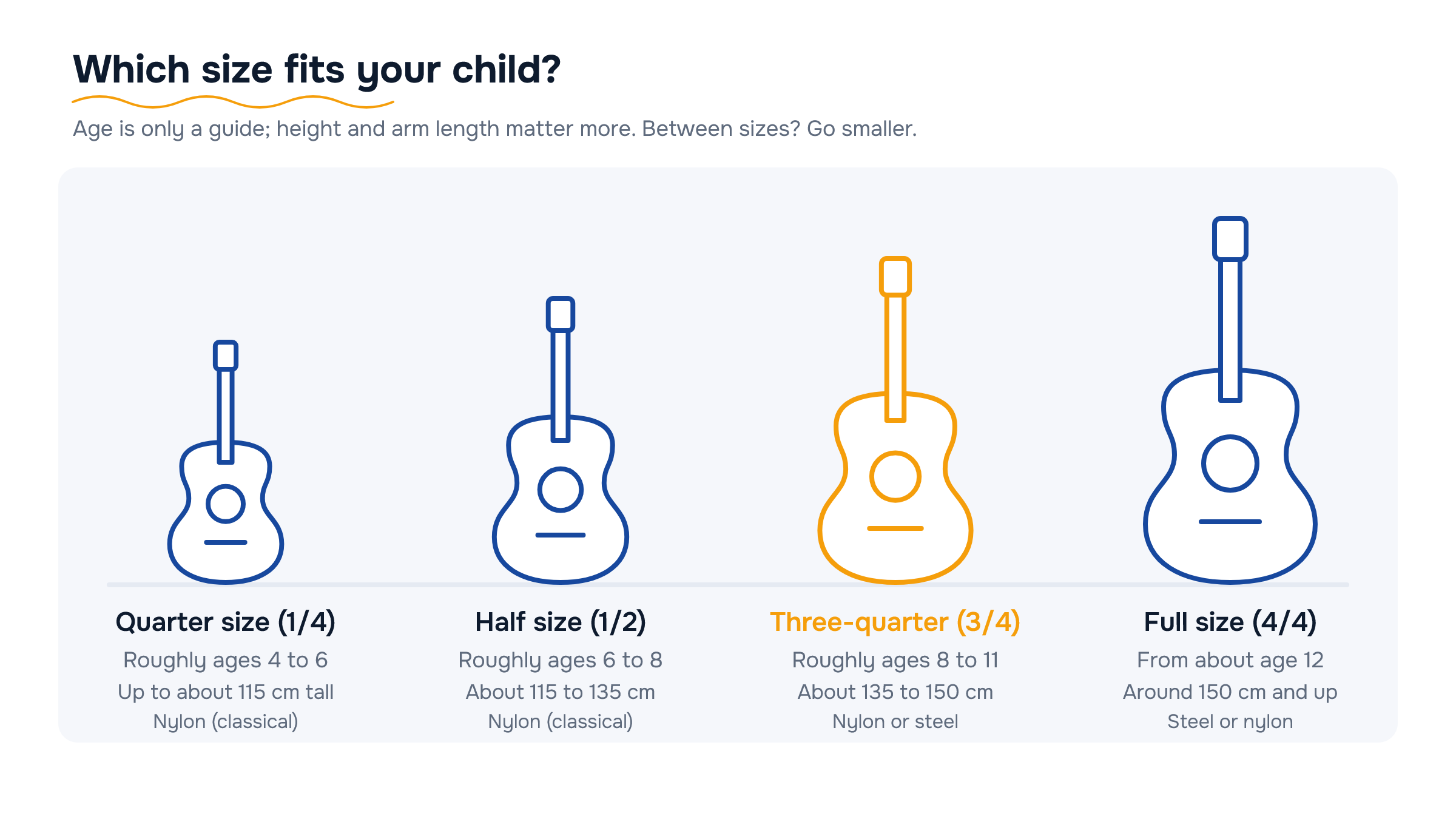
Fractional guitars exist because a full-size guitar in small hands is a recipe for frustration. As a rule of thumb:
- Quarter size suits roughly ages 4 to 6, up to about 115 cm tall.
- Half size suits roughly ages 6 to 8, about 115 to 135 cm. Our half-size classicals are the most common first guitar we sell for primary schoolers.
- Three-quarter size suits roughly ages 8 to 11, about 135 to 150 cm, and comes in nylon or steel. See the three-quarter size acoustics.
- Full size is right from about age 12, or around 150 cm and up.
Age is only a guide; height and arm length matter more. Sitting down, your child's strumming arm should drape over the body without the shoulder hiking up, and the fretting hand should reach the first fret without a full stretch. Between sizes? Go smaller. Comfort beats growing room every time, because the comfortable guitar is the one that gets played.
For the under-fives, also consider a ukulele as a first step. It's cheaper, smaller and quicker to get a song out of; our ukulele guide covers it properly.
Solid top vs laminate: when it actually matters
The top (the soundboard) does most of a guitar's sound-making, so it's the one spec genuinely worth paying for. A laminate top is layers of pressed timber: tough, stable and cheap to build. A solid top, usually spruce or cedar, is a single piece of timber that vibrates more freely, sounds richer, and actually improves as it's played in over the years.
Under about $300, nearly everything is laminate, and that's completely fine. A well-set-up laminate guitar is exactly the right buy for a young child or a try-it-and-see beginner, and it shrugs off knocks, school corridors and temperature swings.
From around $400 to $500, solid tops appear, and that's where we steer anyone who's even half serious. The difference isn't subtle; play the two back to back and you'll hear the solid top ring longer and fuller. From around $1,500 and up you get solid back and sides as well, which is Maton territory and where guitars become genuinely lifelong instruments.
One care note for solid timber: keep it away from heater vents and out of hot cars, and it will look after you for decades.
With pickup (acoustic-electric): who actually needs it
An acoustic-electric is simply a normal acoustic with a pickup and preamp built in, so it can plug into an amp or PA. Unplugged, it sounds exactly like the same guitar without one.
You genuinely need a pickup if you'll perform: open mics, gigs, church, school concerts, anywhere you must be louder than the room. Singer-songwriters who plan to play out should buy from the with-pickup range from day one, and most onboard preamps include a tuner, which is a handy bonus.
You don't need one for bedroom practice, lessons or the campfire. The electronics add to the price without changing the unplugged sound, and a quality pickup can always be retrofitted later if your plans change. If the budget is tight, put that money into a better top instead; you'll hear it every single day, not just on stage.
Action, setup and what else you'll need
Action is the height of the strings above the frets, and it makes or breaks a beginner. High action means pressing harder for every single chord, and it's the number-one reason cheap, unchecked guitars end up in cupboards. It's also why we'd rather you buy a properly set-up $250 guitar than a poorly set-up $400 one.
Everything we sell is genuine, authorised Australian-dealer stock with the full manufacturer warranty. And when your strings go dull, our in-store restring service is $55 plus the cost of strings, fitted with a clean included.
Day-one extras worth having: a clip-on tuner, a spare set of strings, a few picks (start thin for strumming), a gig bag if one isn't included, a stand so the guitar lives out of its case and gets played, and a capo once chords arrive. A footstool helps young classical players sit properly. A good beginner's pack bundles most of this with the guitar and takes the guesswork out.
Orders over $150 ship free Australia-wide, tracked and insured, with same-day dispatch on weekday orders before 2pm AEST, or grab Click & Collect from the Footscray showroom. Afterpay and Zip are there if you'd rather pay in instalments. Still tossing up between two sizes or shapes? Call us on 03 4151 5751 or drop into 284-288 Ballarat Rd, Footscray and play them back to back. It's the fastest way to know.
What your budget gets you
Under $300
First guitars for kids, and adults testing the waters without overcommitting.
Laminate construction, which is fine at this level. Insist on a guitar that's been checked and set up, with tuning machines that hold pitch; a beginner's pack adds the bag, tuner and picks in one hit.
Shop Beginner's Packs under $300 →$300-$700
Committed beginners and returning players who want a guitar worth keeping.
Solid tops appear from around $400-$500 with noticeably richer tone. Better tuners and neck feel, and the guitar starts being an instrument rather than a starter.
Shop Acoustic $300–$700 →$700-$1,500
Gigging singer-songwriters and improving players after their for-years guitar.
Solid tops as standard, quality pickups and preamps, and better fit and finish. This is the sweet spot for an acoustic-electric you'll actually perform with.
Shop With Pickup (Acoustic/Electric) $700–$1,500 →Around $1,500+
Serious players ready for a lifetime instrument.
All-solid timber, back and sides as well as the top, with tone that keeps improving for decades. This is where Australian-made Matons live, and they hold their value accordingly.
Shop Dreadnought from $1,500 →Compare at a glance
| Type | Best for | Watch out for | Typical spend |
|---|---|---|---|
| Quarter-size classical (nylon) | Ages 4-6, under about 115 cm tall | They outgrow it quickly, so keep it simple and playable | Under $200 |
| Half-size classical (nylon) | Ages 6-8, about 115-135 cm; the classic school starter | Cheap tuning machines that won't hold pitch | Under $250 |
| Three-quarter size (nylon or steel) | Ages 8-11, about 135-150 cm, plus travel use | Steel three-quarters are tougher on young fingers than nylon | $150-$400 |
| Folk / orchestral (steel) | Singer-songwriters, fingerpickers, smaller-framed teens and adults | Less boom than a dreadnought under heavy strumming | $300-$1,500+ |
| Dreadnought (steel) | Strummers, campfire singalongs, the classic all-rounder | The big body can be a stretch for smaller players | $300-$1,500+ |
| Traveller / mini (steel) | Holidays, small spaces, older kids stepping up from three-quarter | Smaller body means less volume and bass than a full size | $200-$700 |
Common mistakes to avoid
- Buying a full-size guitar for a young child to grow into A guitar they can't reach around is a guitar they won't play. Buy the size that fits today; fractional guitars make great hand-me-downs and resell easily.
- Treating nylon as the beginner option for adults Nylon isn't easier-mode steel; it's a different sound for different music. Pick the string type that matches what you want to play, and let your fingertips toughen up for a fortnight.
- Ignoring the action High strings make every chord a fight and are the single biggest reason beginners quit. If a guitar feels hard to press everywhere, it needs adjustment, not more effort.
- Paying for a pickup you'll never plug in If you won't perform, that money buys a better top instead, and you'll hear the difference every day. Pickups can always be retrofitted later.
- Fitting steel strings to a classical guitar Classical guitars are built for nylon tension only; steel strings can lift the bridge and bow the neck. If in doubt about what your guitar takes, ask us before you restring.
Your questions, answered
Should a beginner start on nylon or steel strings?
For kids under about ten, nylon: it's gentler on small fingers, comes in child sizes, and is what most school programs use. For teens and adults, choose the sound you want to make: steel for pop, folk, rock and country strumming; nylon for classical, flamenco and softer fingerstyle. Sore fingertips on steel are normal and pass within two to three weeks.
What size guitar does my 7-year-old need?
Most 7-year-olds suit a half-size nylon-string guitar, which fits kids roughly 115 to 135 cm tall. If they're tall for their age or nearly eight, a three-quarter may already fit. Height and arm reach matter more than age, so if you're unsure, bring them into the Footscray store and we'll size them up in two minutes.
Is a solid top worth the extra money for a beginner?
For a young child, no: a durable laminate guitar under $300 is the smarter buy. For a teen or adult who's reasonably committed, yes: from around $400-$500 a solid top sounds noticeably richer, improves as it's played in, and keeps motivation up. It's the single most worthwhile spec upgrade on an acoustic.
Do I need an acoustic guitar with a pickup?
Only if you plan to perform: open mics, gigs, church or school concerts. Unplugged, the same guitar sounds identical without one. A quality pickup can be retrofitted later, so there's no need to pay for one just in case.
My child is left-handed. Should I buy a left-handed guitar?
Plenty of left-handers play right-handed, and if your child is starting completely fresh it's worth trying right-handed first, since both hands work hard anyway. If they already instinctively strum left-handed, buy a proper left-handed guitar rather than flipping a right-handed one, because the nut and bracing are made for it. We stock dedicated left-handed acoustics.
How much should I spend on a first acoustic guitar?
For a child, under $250 on a properly set-up fractional classical is plenty. For a teen or adult, $200-$400 buys a reliable steel-string or a beginner's pack with the accessories included; stretch toward $500 for a solid top if you know you'll stick at it. Afterpay and Zip are available if you'd rather split the cost into instalments.
Can you restring the guitar I buy, or one I already own?
Yes. In-store restrings are $55 plus the cost of strings, fitted with a clean included. And if anything about your guitar feels hard to play, call 03 4151 5751 or bring it into the Footscray shop and one of the players on the floor will take a look.
Shop the categories in this guide
Keep reading: Guitar Strings Buying Guide · Ukulele Buying Guide · Electric Guitar Buying Guide
Try our in-store range in Footscray
Come and play what we’ve got on the floor side by side — real players on hand, honest advice, and genuine authorised Australian stock with full manufacturer warranty. Call ahead and we’ll check what’s in store for you to try.
Talk to our experts — in-store or on the phone
Still torn between two? Our team are real players who know this gear inside out. Call us, message us, or drop in and play what we’ve got in store. Reserve online for Click & Collect — we’ll confirm it’s ready before you come in — genuine stock, full manufacturer warranty, and your Consumer Law rights always apply.
Visit the Footscray showroom
Why you can trust this advice
Written & reviewed by
The Scarlett Music Team
Footscray showroom & workshop · Independent dealer since 1997
This guide is written by the same team that sells, demos and plays this gear six days a week — so our picks come from hands-on experience with the actual instruments, not a spec sheet. We only recommend genuine, authorised Australian stock, and pricing and availability are reviewed and updated regularly.





Leave a comment