How to Choose a PA System
Real-world advice on sizing a PA for your room and crowd, powered vs passive speakers, mixers, monitors and subs - from the players on the Scarlett floor.
A PA system carries your voice and instruments out to the room, and the right one depends almost entirely on two things: how big the space is and how many people are in it. Whether you're a solo acoustic act, a covers band, a school hall, a church or a function venue, this guide walks you through the real numbers so you buy once and buy right.
We sell and play this gear every week, so we'll keep it plain. Count your inputs, match the power to the room, sort your monitoring, and don't forget the cables and stands that quietly make or break a gig. Here's how to put it all together.
How much power and how many speakers
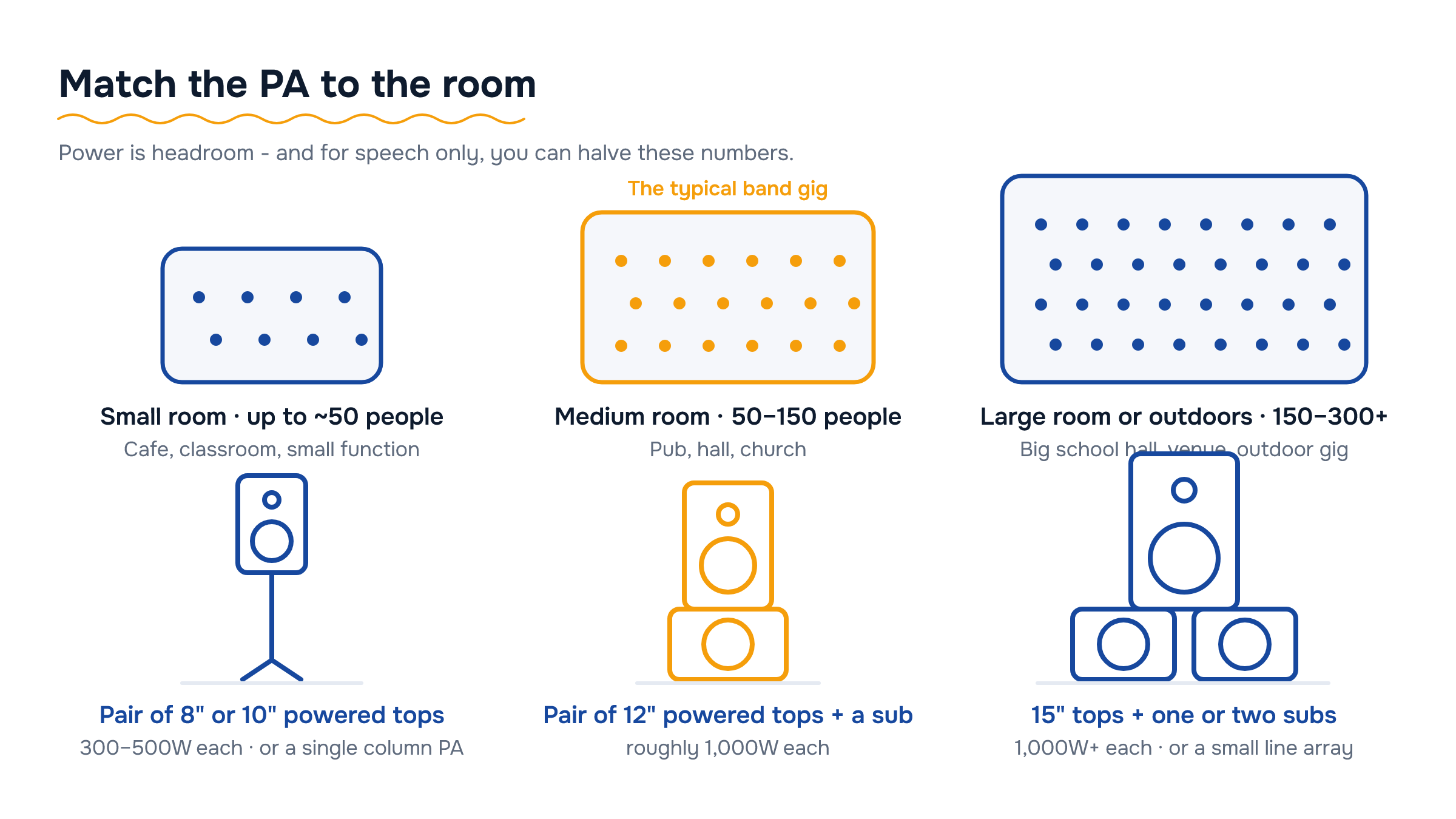
Power is your headroom. You want enough that the system sits comfortably, not flat-out, because a PA pushed to its limit distorts, sounds harsh and eventually fails. As a rough working guide for music with vocals:
- Small room, up to ~50 people (cafe, classroom, small function): a pair of 8" or 10" powered tops, around 300-500W each, or a single column PA.
- Medium room, 50-150 people (pub, hall, church): a pair of 12" powered tops, roughly 1,000W each, and you'll likely want a sub.
- Large room or outdoors, 150-300+: 15" tops at 1,000W+ each plus one or two subs, or a small line array.
For speech only - assemblies, presentations - you can halve those numbers. Two speakers beat one almost every time: it spreads the sound evenly and stops the front row getting blasted while the back can't hear. Browse the range under Shop all PA Systems or individual Speakers to see what fits.
Powered vs passive speakers
This is the first real fork in the road. Powered (active) speakers have the amplifier built in - plug in power and a signal cable and you're running. Passive speakers have no amp; they need a separate power amplifier and speaker cables to drive them.
For almost every band, school, church and solo act, powered is the right call. Fewer boxes to carry, less to wire up wrong, the amp is matched to the driver from the factory, and you can grab one speaker for a small job. It's the simpler, more forgiving choice.
Passive systems still earn their place in fixed installs - a hall or venue where the amp lives in a rack and never moves - because you can run long cable runs and tailor the amp to the room. But for anything you load in and out, powered wins on convenience and reliability. You'll find both among our Loudspeakers. If you go passive, remember to budget for a power amp and proper speaker leads.
Planning your mixer: count your inputs
The single most common mistake is buying a mixer that's too small. The fix is easy: count every input, then add two. A vocal mic, a second vocal, an acoustic guitar DI, a keyboard (two channels in stereo), a backing-track feed - that's six already, so an 8-channel desk is your real minimum.
Tally it up honestly for your busiest gig:
- Each vocalist = one channel
- Each instrument mic or DI = one channel
- Stereo sources (keys, laptop, playback) = two channels
- Then add two spare for the input you forgot
Decide between an analogue desk (every control on the surface, dead simple under pressure) and a digital mixer (recallable scenes, onboard effects, app control from the floor, often more compact). Digital is brilliant once you've climbed the small learning curve. Many compact powered mixers also build the amp in, which suits passive-speaker setups. See the full range under Mixers, and pair it with the right Microphones for the job.
Column and portable PAs for solo acts
If you're a solo singer-guitarist, a duo, or a presenter who moves between rooms, a column (line array) PA is hard to beat. These are the tall, slim systems with a sub at the base and a thin column of small drivers above. They throw sound evenly down the room, they're light, and most pack into two trips to the car.
The big draw is that many column PAs have a mixer built into the base - typically three to six channels with Bluetooth, reverb and sometimes onboard effects - so for a small acoustic gig that one box plus a mic and a DI is your entire rig. For up to roughly 100-150 people they sound clean and natural, especially on voice.
If you regularly play bigger or louder rooms, or you're a full band, you'll outgrow a single column and want separate tops and a sub. But for coffee shops, weddings, corporate spots and acoustic nights, a column PA is the easiest, best-sounding option going. Have a look across PA Systems.
Monitors, foldback and subwoofers
Monitors (foldback) are the speakers that point back at the performers so you can hear yourself. Without them you'll push too hard, drift off pitch and have a miserable night. The classic answer is a wedge monitor on the floor angled up at each key position - usually the lead vocal first, then anyone else who needs it. Browse Stage Monitors.
The modern alternative is in-ear monitoring - cleaner stage, better hearing protection, and consistent sound wherever you stand. It's a great move for bands tired of stage volume wars; see In-Ear Monitors.
Subwoofers handle the low end your tops can't. You want one (or two) when you've got kick drum, bass guitar, electronic tracks or DJ playback, or any time the room is over ~100 people and you need weight rather than just volume. A pure acoustic duo or a speech-only assembly usually doesn't need a sub at all. When you do, a powered sub also acts as a stand base for your tops, which tidies the whole rig. See Subwoofers. Not sure what suits your room? Call us on 03 4151 5751 or come and hear it for yourself at our Footscray showroom.
Cables, stands and the bits people forget
The gear that ruins gigs is rarely the speakers - it's the missing lead or the stand left at home. Build a checklist and keep a spare of everything that's cheap:
- XLR mic cables - one per mic, plus two spares. Buy lengths that actually reach.
- Speaker stands - get your tops up to ear height; sound on the floor is muffled and uneven.
- A DI box for acoustic guitar, keys or a laptop feed.
- Mic stands - boom stands for vocals and instruments.
- A power board with surge protection, and enough extension lead to reach the wall.
- Gaffer tape to tape down anything anyone could trip on.
Sort your Cables, Speaker Stands, Microphone Stands and other Parts & Accessories in one go and you'll never be caught short. If it's a one-off event and you don't want to own a full rig, ask our team about hire options. Better still, pop into Footscray and we'll help you build the exact list for your gig - tag along to the counter and we'll plug it in so you can hear it.
What your budget gets you
Under $500
Solo acoustic acts, classrooms and presenters who need clean voice in a small room.
A compact column PA or a single powered top with a built-in mixer and Bluetooth. Plenty for up to ~50 people; check the channel count covers a mic plus an instrument.
Shop PA Systems under $500 →$500-$1,500
Duos, small bands, churches and function rooms doing real gigs.
A pair of 10" or 12" powered tops, or a serious column system, plus a small mixer. Look for enough headroom that it isn't maxed out at full volume.
Shop Speakers $500–$1,500 →$1,500-$3,000
Gigging bands and busy venues needing weight and reliability week in, week out.
12" or 15" powered tops, a powered sub, a capable digital mixer and a couple of monitors. Check it all fits your car and your load-in.
Shop Mixers $1,500–$3,000 →$3,000+
Larger venues, schools with big halls, and bands covering 200-300+ rooms.
A small line array or dual-15 tops with twin subs, proper monitoring and a full digital console. This is buy-once territory - get the room sizing right first.
Shop Subwoofers from $3,000 →Compare at a glance
| Type | Best for | Watch out for | Typical spend |
|---|---|---|---|
| Column / portable PA | Solo acts, duos, presenters, small rooms | Runs out of grunt for full bands or big crowds | Under $500-$1,500 |
| Powered tops (pair) | Bands, churches, function rooms | Need stands; add a sub for low end | $500-$2,000 |
| Powered tops + sub | Gigging bands, venues, DJ playback | More boxes to carry and store | $1,500-$3,000 |
| Passive system + amp | Fixed installs, halls, permanent venues | Extra amp and cabling; less portable | $1,000-$3,000+ |
| Small line array | Large rooms, outdoor events, 200-300+ | Higher cost; overkill for small gigs | $3,000+ |
Common mistakes to avoid
- Buying too little power A PA run flat-out distorts, sounds harsh and dies young. Always leave headroom - size for a bit more than you think you need, not the bare minimum.
- A mixer with too few channels Run out of inputs mid-set and you're stuck. Count every mic, DI and stereo source for your busiest gig, then add two spare channels.
- Skipping monitors If performers can't hear themselves they push too hard and drift off pitch. Budget for at least one wedge or in-ears from the start, not as an afterthought.
- Forgetting stands and cables Speakers on the floor sound muddy, and a missing XLR ends a gig. Get tops up to ear height and carry spares of every cheap cable.
- Adding a sub you don't need A pure acoustic act or a speech-only assembly gains nothing from a sub but weight and cost. Add one only when there's real low end - kick, bass or playback.
Your questions, answered
How many watts do I need for a band?
For a typical pub or hall of 50-150 people, aim for a pair of 12" powered tops around 1,000W each, plus a sub. For smaller rooms up to 50 people, 300-500W per side is plenty. Power is headroom, so it's better to have a little spare than to run the system flat-out.
Powered or passive speakers - which should I get?
For anything you load in and out, powered (active) speakers are the easier, more reliable choice: the amp is built in and matched to the driver. Passive systems make sense for fixed installs in a hall or venue where the amp lives in a rack. Most bands, schools, churches and solo acts should go powered.
What size mixer do I need?
Count every input you use at your busiest gig - each vocal, each instrument mic or DI, and two channels for any stereo source - then add two spare. That total is your minimum channel count. It's far better to have a couple of unused channels than to run out mid-set.
Do I need a subwoofer?
You want a sub when there's real low end to carry - kick drum, bass guitar, electronic tracks or DJ playback - or when the room is over about 100 people and you need weight. A solo acoustic act or a speech-only assembly usually doesn't need one at all.
What's the easiest PA for a solo acoustic act?
A column (line array) PA with a built-in mixer. It's light, throws sound evenly down the room, and many models have three to six channels plus Bluetooth in the base, so one box covers your mic, guitar and backing tracks. It's the cleanest, simplest rig for up to roughly 150 people.
Can I hire a PA for a one-off event?
Yes - if you've got a single event and don't want to own a full rig, hire can be the smart move. Ask our team and we'll talk through what suits your room and crowd. Give us a call on 03 4151 5751 or visit the Footscray showroom.
What cables and accessories do I need to start?
At minimum: an XLR cable per microphone plus spares, speaker stands to lift your tops to ear height, mic stands, a DI box for acoustic or keys, and a surge-protected power board. Tape down anything anyone could trip on. We can build the exact list for your setup in-store.
Shop the categories in this guide
Keep reading: Choosing Microphones · Home Recording Guide · Headphones & Monitors Guide
Try our in-store range in Footscray
Come and play what we’ve got on the floor side by side — real players on hand, honest advice, and genuine authorised Australian stock with full manufacturer warranty. Call ahead and we’ll check what’s in store for you to try.
Talk to our experts — in-store or on the phone
Still torn between two? Our team are real players who know this gear inside out. Call us, message us, or drop in and play what we’ve got in store. Reserve online for Click & Collect — we’ll confirm it’s ready before you come in — genuine stock, full manufacturer warranty, and your Consumer Law rights always apply.
Visit the Footscray showroom
Why you can trust this advice
Written & reviewed by
The Scarlett Music Team
Footscray showroom & workshop · Independent dealer since 1997
This guide is written by the same team that sells, demos and plays this gear six days a week — so our picks come from hands-on experience with the actual instruments, not a spec sheet. We only recommend genuine, authorised Australian stock, and pricing and availability are reviewed and updated regularly.





Leave a comment