
Guitar Strings Guide: Gauges, Materials & When to Change
Which gauge, which material and how often to change them — a plain-English guide to guitar strings from the Footscray crew who restring guitars every week.

New strings are the cheapest upgrade in guitar. A fresh set costing less than a takeaway lunch will make a tired instrument sound brighter, hold its tuning better and feel nicer under your fingers than anything else you can spend money on.
This guide is for everyone: beginners who've just been told 'it needs new strings', parents shopping for a school classical, and regulars after a straight answer on gauges, bronzes and coatings. We restring guitars every week at the Footscray shop, so this is exactly the advice we give over the counter.
How often should you change your strings?
The honest answer depends on playing time, not the calendar. Strings die from sweat, skin oils and humidity, and they corrode even sitting in the case untouched.
- Playing daily or gigging: every 4-6 weeks. Working players often change more often than that, sometimes per gig.
- A few sessions a week: every 2-3 months is about right.
- Casual playing, an hour or two a week: every 3-4 months — and twice a year at an absolute minimum, even if the guitar mostly sits on the stand.
The telltale signs it's time: the tone has gone dull and thumpy, the guitar won't hold tune, the strings look grey or brown instead of shiny, or you can feel grit and flat spots when you run a finger along them. If you can't remember when you last changed them, that's also your answer.
Parents: if your child's teacher says the guitar needs new strings, they're right. Old strings make a perfectly good guitar sound far worse than it is, and they make learning harder than it needs to be. Wiping the strings with a dry cloth after playing genuinely extends their life, and a basic string cleaner from our care products shelf helps too.
Gauge in plain English: 9s, 10s, light and medium
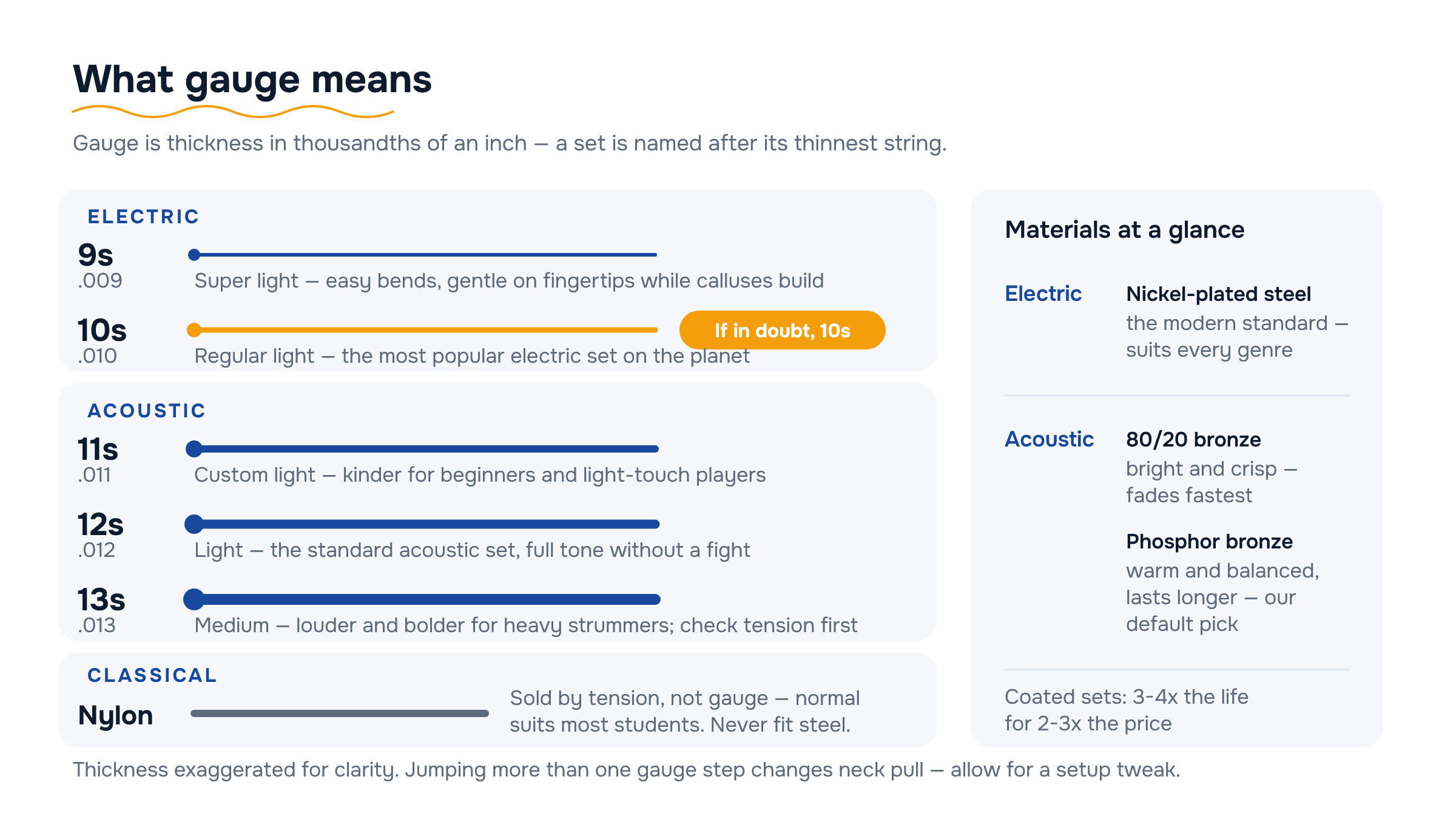
Gauge just means thickness, measured in thousandths of an inch, and a set is named after its thinnest string. So '9s' run from .009 to .042, and '10s' from .010 to .046. Thinner strings are easier to press and bend; thicker strings give fuller tone and more volume but ask more of your fingers.
- Electric 9s (super light): the kindest choice for beginners — easy bends, gentle on fingertips while calluses build.
- Electric 10s (regular light): the most popular electric set on the planet. Slightly fatter tone, stays settled under hard strumming. If in doubt, 10s.
- Acoustic light (12s): the standard acoustic set — full tone without fighting the guitar.
- Acoustic custom light (11s): a kinder option for beginners and light-touch players, with a small trade-off in volume.
- Acoustic medium (13s): louder and bolder for heavy strummers — genuinely hard work, and worth checking your guitar is built for the extra tension first.
One caution: jumping more than one step in gauge changes the pull on the neck, so the guitar may need a setup tweak to play its best afterwards. You can browse every gauge we stock in our strings department.
Acoustic strings: 80/20 bronze vs phosphor bronze
Steel-string acoustic sets come in two main flavours, and the difference is real but simple.
80/20 bronze (80 per cent copper, 20 per cent zinc) is the bright, crisp option. It sparkles when new and cuts through nicely if you strum with a pick or play alongside other instruments. The trade-off is that the brand-new zing fades fastest of any string type.
Phosphor bronze adds a little phosphorus to the alloy, which warms the tone and slows corrosion. It's balanced, a touch sweeter in the mids, and holds its sound noticeably longer. This is our default recommendation for most acoustic players, and D'Addario phosphor bronze sets are our biggest seller for exactly that reason.
A simple rule of thumb: if you fingerpick, record or play solo, go phosphor bronze for the warmth and longevity. If you're a strummer who loves that fresh-strings shimmer and doesn't mind changing more often, try 80/20. Both are stocked in every common gauge in our acoustic guitar strings range, so it costs very little to try one of each and pick a side.
Electric strings: nickel vs steel
Nickel-plated steel is the modern standard — a steel core wrapped in nickel-plated wire. Ernie Ball Slinkys and D'Addario XLs, the two best-selling electric sets in the world, are both nickel-plated steel. You get a balance of brightness and warmth that suits every genre, and a smooth, familiar feel. Unless you have a specific reason to stray, this is the one.
Pure nickel is the vintage option: warmer, smoother and slightly lower output. Lovely for blues, rockabilly and classic rock tones, especially through a clean or lightly driven amp.
Stainless steel is the brightest and most corrosion-resistant of the three. If your hands sweat heavily or you chew through strings, stainless lasts longer and keeps its bite. It feels a touch stiffer under the fingers and is marginally harder on frets, which is why we suggest it as a solution to a problem rather than a starting point.
All three live in our electric guitar strings range. For most players the practical decision isn't nickel versus steel at all — it's picking a gauge of nickel-plated set and sticking with it so your guitar always feels the same.
Classical strings — and why never steel on a classical
Classical guitars take nylon strings, and instead of gauges they're sold by tension. Normal tension is the right call for beginners, students and most players: easier on the fingers and easy for the guitar. Hard tension pulls tighter for more volume and projection, with a stiffer feel — worth it once your technique has developed, or if you need to fill a room without amplification.
Now the rule we'd print in capital letters if we could: never put steel strings on a classical guitar. A classical has light bracing, a glued tie-block bridge and usually no truss rod in the neck. Steel strings roughly double the tension the instrument was built for, and the result is a bowed neck, a lifting bridge, or both. We see the damage come through the workshop door, and it's often not repairable on a student guitar.
It cuts the other way too. Nylon strings on a steel-string acoustic won't anchor properly and sound limp, and on an electric they won't drive the magnetic pickups at all. Match the set to the guitar: half-size and three-quarter-size school guitars are almost always classicals, so they take normal-tension nylon from our classical guitar strings range. Not sure what you've got? A photo of the headstock is usually all we need to tell you.
Coated strings, and DIY vs the in-store restring
Coated strings wrap the wire in a micro-thin polymer that blocks sweat and grime. They cost roughly two to three times more than uncoated and last three to four times longer, so the maths works out fine. They're genuinely worth it if your sweat eats strings, if you play only occasionally (uncoated strings die in the case regardless), or if you simply hate restringing. Modern coated sets like D'Addario's XT range and Ernie Ball Paradigm feel very close to uncoated — just fractionally slicker, with a touch less brand-new zing.
Restringing yourself is a 20-30 minute job with a cheap string winder and a pair of cutters, and it's a skill worth learning — every guitarist should know how. Electric and steel-string acoustic changes are straightforward; classical tie-knots, 12-strings and locking tremolos are where most people come unstuck.
Or skip the hassle entirely: our in-store restring service is $55 plus the cost of strings, and it includes a clean — fresh strings fitted, stretched in and tuned, with the guitar cleaned up while we're at it. It's the easy answer for fiddly jobs, school guitars and anything that hasn't been touched in years.
Not sure what your guitar takes? Call us on 03 4151 5751 or bring it into the Footscray showroom at 284-288 Ballarat Rd — we'll have it sorted in minutes, and you can feel a few different sets on the wall while you're here.
What your budget gets you
Under $15
Everyday electric players and anyone on a tight budget.
Genuine name-brand uncoated electric sets — Ernie Ball Slinkys and D'Addario XLs live here. There's no need to spend more for great electric tone.
Shop Electric Guitar Strings under $15 →$15-$30
Most acoustic and classical players.
Quality phosphor bronze and 80/20 acoustic sets, plus normal and hard tension classical sets. This is the sweet spot for steel-string acoustics.
Shop Acoustic Guitar Strings $15–$30 →$30-$60
Coated-string converts and stock-up buyers.
Coated sets that last three to four times longer, and multi-packs that bring the per-set price right down. Stock up past $150 and shipping is free Australia-wide.
Shop Strings $30–$60 →$40-$80
Bass players.
Bass sets cost more because there's simply more metal in them — but they also last months longer than guitar strings, so the per-week cost is similar.
Shop Bass Guitar Strings $40–$80 →Compare at a glance
| Type | Best for | Watch out for | Typical spend |
|---|---|---|---|
| 80/20 bronze (acoustic) | Bright, crisp strumming that cuts through a room | Loses its sparkle quicker than phosphor bronze | $15-$30 |
| Phosphor bronze (acoustic) | Warm, balanced all-rounder — the safe default | Slightly less initial zing than 80/20 | $15-$30 |
| Nickel-plated steel (electric) | Every genre; the standard electric set | Nothing much — it's the benchmark for a reason | $10-$25 |
| Stainless steel (electric) | Bright attack, sweaty hands, long sessions | Stiffer feel; marginally harder on frets | $15-$30 |
| Nylon, normal or hard tension (classical) | Classical and school guitars; beginners' fingers | Hard tension is stiffer and louder — normal suits most students | $15-$30 |
| Coated (acoustic or electric) | Occasional players and string-eating sweat | Two to three times the upfront cost; fractionally slicker feel | $30-$55 |
Common mistakes to avoid
- Putting steel strings on a classical guitar Steel roughly doubles the tension a classical was built for, bowing the neck and lifting the bridge. It's the most expensive string mistake there is — classicals take nylon, always.
- Replacing only the string that broke One bright new string against five dull ones sounds odd and won't balance. If one string has died of old age, the rest are right behind it — change the set.
- Jumping two gauges without a setup Going from 9s to 11s changes the pull on the neck and can leave strings buzzing or sitting high. Move one step at a time, or budget for a small setup adjustment.
- Trying to revive dead strings Boiling or scrubbing old strings buys you days, not weeks, and the tone never fully comes back. A fresh set is one of the cheapest things in music — just change them.
- Letting strings rust because the guitar 'isn't played much' Strings corrode in the case whether you play or not, and rusty strings are rough on young fingers. For a guitar that comes out occasionally, coated strings are made for exactly this.
Your questions, answered
How do I know which type of strings my guitar needs?
Quick check: clear or white strings on a guitar with a slotted headstock means classical, so buy nylon. Shiny steel strings on an acoustic with a round soundhole and pin bridge means a steel-string acoustic set. Solid body with pickups means electric strings. If you're not sure, call us or send a photo — it takes us seconds to identify.
What gauge should a beginner start on?
On electric, 9s — they're the easiest to press and bend while fingertips toughen up. On steel-string acoustic, 11s or 12s. On classical, normal tension nylon. Comfort matters more than tone at the start; a beginner who isn't in pain practises more.
Are coated strings actually worth the extra money?
For the right player, absolutely. If your sweat kills strings quickly, or the guitar only comes out once or twice a week, coated sets last three to four times longer for two to three times the price, so you come out ahead. Daily players who love that fresh-string zing often stick with uncoated and just change more often.
Can you restring my guitar for me?
Yes — restrings in-store are $55 plus the cost of strings, and that includes a clean. We fit, stretch in and tune the new set, and tidy the guitar up while we're at it. Bring it into the Footscray showroom or call 03 4151 5751 first if you'd like to check anything.
Why do my strings go rusty so fast?
Usually it's body chemistry — some people's sweat is simply more acidic and eats string windings in a couple of weeks. Wiping the strings down with a dry cloth after every play helps a lot, and switching to coated strings or stainless steel electric sets solves it for most people.
Do you stock D'Addario and Ernie Ball?
Yes, both — we're an authorised Australian dealer, so it's all genuine stock, no grey imports. Weekday orders before 2pm AEST ship same day with tracking, or you can use Click and Collect from the Footscray showroom.
Can I put electric strings on an acoustic guitar?
They'll physically fit a steel-string acoustic, but they're designed to drive magnetic pickups, so played acoustically they sound thin and quiet. Stick to proper acoustic sets in 80/20 or phosphor bronze — that's what the guitar was voiced for.
Shop the categories in this guide
Keep reading: Acoustic Guitars Buying Guide · Electric Guitars Buying Guide · Guitar Amps Buying Guide
Try our in-store range in Footscray
Come and play what we’ve got on the floor side by side — real players on hand, honest advice, and genuine authorised Australian stock with full manufacturer warranty. Call ahead and we’ll check what’s in store for you to try.
Talk to our experts — in-store or on the phone
Still torn between two? Our team are real players who know this gear inside out. Call us, message us, or drop in and play what we’ve got in store. Reserve online for Click & Collect — we’ll confirm it’s ready before you come in — genuine stock, full manufacturer warranty, and your Consumer Law rights always apply.
Visit the Footscray showroom
Why you can trust this advice
Written & reviewed by
The Scarlett Music Team
Footscray showroom & workshop · Independent dealer since 1997
This guide is written by the same team that sells, demos and plays this gear six days a week — so our picks come from hands-on experience with the actual instruments, not a spec sheet. We only recommend genuine, authorised Australian stock, and pricing and availability are reviewed and updated regularly.





Leave a comment