
How to Choose Your First Guitar Pedals
The classic first five pedals, what order to buy them, and how to power and wire it all — plain-English advice from the team at Scarlett Music in Footscray.
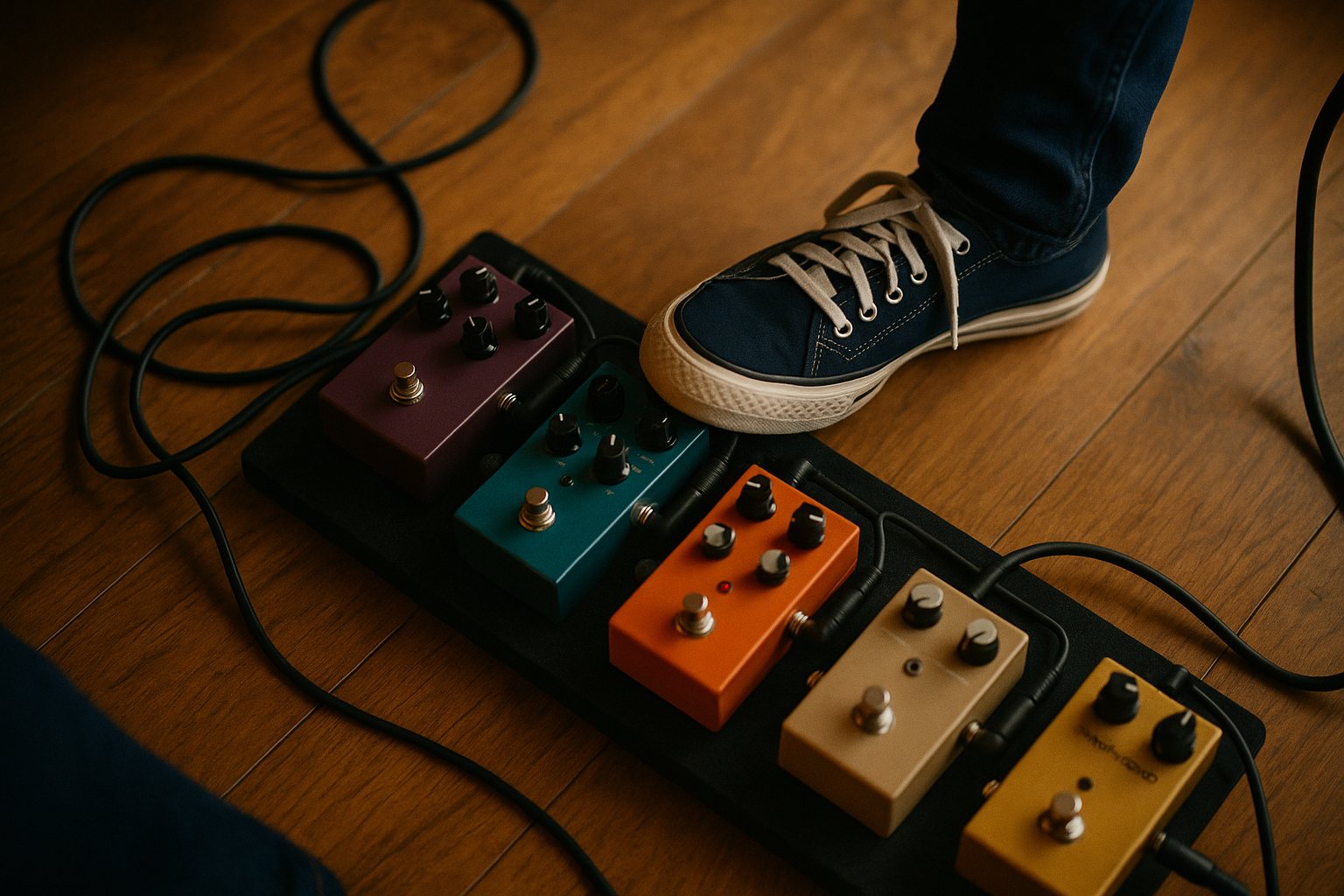
There's a moment every guitarist remembers: the first time you stomp on a drive pedal and your amp suddenly sounds like the records you grew up on. This guide is for players buying their first pedals — and for anyone buying a gift for one — written by the people who set up and sell these boards every week on our Footscray floor.
We'll cover the classic first five pedals and the order to buy them, how to chain them together, the honest case for and against multi-effects, and the unglamorous stuff — power, boards and cables — that makes it all work. No hype, and no twelve-pedal shopping list.
The classic first five, in buying order
Ask anyone on our floor and you'll get the same five pedals, in the same order. It's the order we'd buy them ourselves, because each one earns its keep before you move to the next.
- Tuner. First, always. A tuner pedal (think Boss TU-3 or Korg Pitchblack) sits at the front of your chain, mutes your signal while you tune, and is bright enough to trust on a dark stage. Under $100, and it'll outlast every other pedal you buy.
- Overdrive or distortion. The fun one — the crunch and sustain on practically every rock record ever made. Start browsing overdrive pedals; more on the flavours below.
- Delay. Echo, from short rockabilly slapback to long ambient trails. A simple delay pedal makes solos sound instantly more expensive.
- Reverb. The sense of playing in a room, a hall or a cathedral. If your amp already has reverb built in — many do — push a reverb pedal down the list and spend the money elsewhere.
- Looper. The best practice tool ever put in a metal box. Record a four-chord progression on a looper pedal, then practise scales and solos over yourself for hours.
You don't need all five at once. A tuner plus one good drive pedal is a genuinely great place to live for your first six months.
Overdrive, distortion or fuzz?
All three make your guitar sound dirty; the difference is how hard they push.
- Overdrive is the warm, edge-of-breakup crunch of a valve amp working hard — blues, classic rock, indie, pub covers. The Ibanez Tube Screamer and Boss SD-1 have been the standards for over forty years for good reason.
- Distortion is harder and more saturated — hard rock, punk and metal territory. A distortion pedal like the Boss DS-1 keeps its gain character at bedroom volume, which is exactly what a small practice amp can't do on its own.
- Fuzz is the woolly, splattery sound of the late '60s and early '70s — Hendrix, early Sabbath. Brilliant, but a fuzz pedal is a personality, not a workhorse.
For most beginners, overdrive is the right first call: it suits the widest range of styles, it stacks well with other pedals later, and it cleans up when you roll your guitar's volume knob back — so one pedal covers everything from light grit to nearly clean. If your heart belongs to metal, skip straight to distortion and don't let anyone talk you out of it.
Signal chain order, in plain English
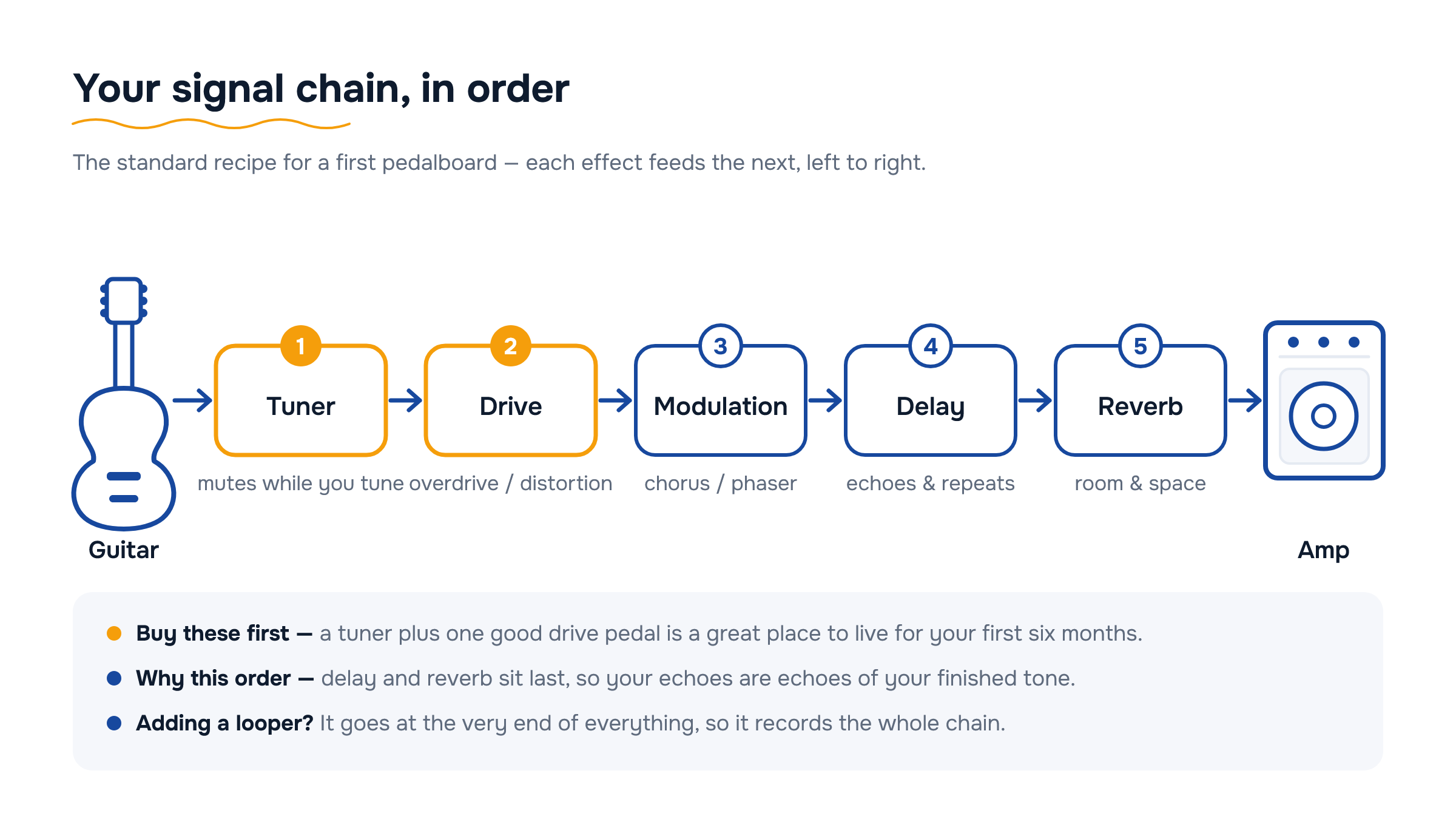
Your signal runs from guitar to amp through one pedal after another, and the order changes the sound. The standard recipe:
- Guitar into tuner — the tuner reads your signal clean and mutes everything behind it.
- Drive pedals next — overdrive, distortion or fuzz, close to the guitar.
- Modulation after the drives — chorus and vibrato, phaser, flanger: the swirly stuff.
- Delay, then reverb, last — so your echoes are echoes of your finished tone.
The reasoning is simple. Delay placed after a drive pedal repeats your dirty tone cleanly — that's the sound you know from records. Drive placed after delay distorts the repeats themselves, which turns to mush fast. A looper goes at the very end of everything, so it records the whole chain.
These are starting points, not laws — plenty of classic records were made with the "wrong" order. Set your board up the standard way first, learn what it does, then break the rules on purpose.
Multi-effects vs single pedals — the honest version
A multi-effects unit packs dozens of effects, amp sounds, a tuner, a drum machine and usually a headphone output into one box — often for the price of two single pedals. For a beginner who doesn't yet know what they like, that's hard to argue with. You can try every effect family for one outlay and learn what chorus, phaser and compression actually do to your sound.
The honest downsides: small screens and shared knobs make tweaking less immediate than reaching down and turning one dial, the built-in amp models matter less if you're playing through a real amp, and a multi-effects unit holds its value worse than a Boss compact someone will happily buy off you in ten years. A very common path is to start on a multi-effects, work out your three favourite sounds, then slowly replace it with the single pedals that do those jobs best.
Our usual advice: if you mostly practise at home on headphones, or you genuinely don't know which effects you want yet, a compact multi-effects in the $200-$500 range is the smart first move. If you already know the sound in your head — that one drive tone you've been chasing — buy it as a single pedal and build from there. Both paths are legitimate; neither is cheating.
Power supplies and daisy chains
Nearly every pedal runs on 9 volts DC through a centre-negative barrel plug — the standard Boss set decades ago. You have three ways to feed them:
- Batteries are fine for one pedal at home, but they become an expensive habit fast, and digital pedals can chew through a 9V in a few hours.
- A daisy chain splits one plugpack across several pedals. Cheap, simple and perfectly good for two to five analogue pedals — tuner, drives, wah.
- An isolated power supply gives every pedal its own clean, separate output. It's the upgrade you make when digital pedals join the board, or when a daisy chain starts to hum.
Two numbers to check on any pedal's box: voltage (9V unless it clearly says otherwise — feeding 18V to a 9V-only pedal can kill it) and current draw in milliamps. Analogue drives sip 10-20mA; digital delays, reverbs and multi-effects can pull 200-500mA. Add your pedals' draw up and make sure the supply covers it with room to spare. If you daisy-chain a hungry digital pedal alongside your drives, you'll often hear the result as a whine that wasn't there before. Power supplies, daisy chains and the rest live in pedal boards and accessories.
Pedalboards, patch cables and putting it together
Once you own three pedals, a board stops being a luxury — it keeps your settings, your wiring and your sanity intact between the lounge room and rehearsal. A small board with space for four or five compact pedals is the right first size: it forces good decisions and fits in a backpack. Hook-and-loop tape holds the pedals down, and the power supply usually mounts underneath.
Cables are where first boards usually go wrong. You'll need short patch cables between each pedal and two decent instrument cables — guitar to board, board to amp. Cheap leads are the number-one cause of the crackles and dropouts customers ask us about, and they're miserable to diagnose mid-song. Solid, affordable options from brands like D'Addario and Ernie Ball are in guitar cables — budget for them from day one.
One last thing: your amp is half your sound, and no pedal can fix an amp that's fighting it — our guitar amps guide covers that side of the equation. And if you'd rather hear all of this before you spend a dollar, come plug in at 284-288 Ballarat Rd, Footscray, or call us on 03 4151 5751 — there's always someone on the floor who plays this gear daily.
What your budget gets you
Under $100
Your very first pedal, or a safe gift for any guitarist.
A quality tuner pedal, a daisy chain and patch cables, or a decent mini pedal. This is exactly where every board should start — no shame in it.
Shop Tuning Pedals under $100 →$100-$250
Adding your first serious drive, delay or looper.
The classic Boss compacts and Ibanez drives live here — gig-tough pedals you'll never outgrow and can resell easily. Orders over $150 ship free Australia-wide.
Shop Overdrive Pedals $100–$250 →$250-$600
One outlay to explore everything, or the core of a single-pedal board.
A compact multi-effects with headphone out and drum patterns, or two to three singles plus power and a small board. Afterpay and Zip can split it into four instalments.
Shop Multi Effects Pedals $250–$600 →Around $1,000+
The complete first board, done properly in one go.
Four or five pedals, an isolated power supply, a quality board and cables — or a serious floor unit that does it all. We price-match other authorised Australian dealers.
Shop Pedal Boards & Accessories from $1,000 →Compare at a glance
| Type | Best for | Watch out for | Typical spend |
|---|---|---|---|
| Single compact pedals | Building one great sound at a time; players who like real knobs | Costs add up — budget for power, a board and patch cables too | $80-$250 per pedal |
| Mini pedals | Tight boards, tight budgets, backup rigs | Fiddly controls, and most can't run on a battery | $60-$150 per pedal |
| Compact multi-effects | Trying every effect before committing; silent headphone practice | Menu-diving; less satisfying to tweak mid-song | $200-$500 |
| Floor modellers / full multi-effects | Amp, effects and recording interface in one; gigging straight to the PA | Steep learning curve — overkill as a very first purchase | $700-$1,500+ |
Common mistakes to avoid
- Buying the fun pedal before the tuner An out-of-tune guitar through a great overdrive still sounds bad — it just sounds louder and bad. The tuner is the least exciting and most-used pedal on every board we build.
- Running everything off one cheap daisy chain Digital delays, reverbs and multi-effects draw far more current than analogue drives, and sharing a cheap chain often adds a whine you'll blame on everything else first. Check the milliamp draw before you buy the power.
- Buying a huge board to grow into A giant half-empty board is an invitation to buy pedals you don't need yet. Start with space for four or five and let your playing tell you what comes next.
- Expecting a pedal to fix the amp A drive pedal into a struggling amp gives you a fizzy version of a struggling amp. If your amp is the weak link, fix that first — our guitar amps guide will sort you out.
- Forgetting the boring bits in the budget Patch cables, power and hook-and-loop tape can add a meaningful chunk on top of the pedals themselves. Price the whole board, not just the fun boxes on top of it.
Your questions, answered
What's the very first pedal a beginner should buy?
A tuner pedal. It's under $100, you'll use it every single time you play, and it mutes your signal so you can tune silently. Once that's sorted, an overdrive or distortion pedal is the first one that changes your sound.
What order should my pedals go in?
The standard chain is guitar, then tuner, then drive pedals, then modulation like chorus or phaser, then delay, then reverb, then into the amp. A looper goes last so it records everything. It's a starting point rather than a law, but it's the right way to begin.
Are multi-effects units good for beginners?
Genuinely, yes — especially if you don't know which effects you want yet or you mostly practise on headphones. One unit in the $200-$500 range lets you try everything. The trade-off is menus instead of knobs, and most players who get serious eventually replace it with a few favourite single pedals.
Can I power all my pedals from one daisy chain?
For a handful of analogue pedals — tuner, overdrive, wah — yes, a daisy chain off one plugpack is fine. Once digital delay, reverb or multi-effects pedals join the board, their higher current draw can overload the chain or add noise, and an isolated power supply becomes the better buy.
I'm buying a gift for a guitarist — which pedal is safest?
A tuner or a looper. Every guitarist needs a tuner, and a looper is the practice tool they didn't know they wanted — neither steps on personal taste the way a drive pedal does. We're an authorised dealer with genuine stock, there's a 30-day return window, and you can Click & Collect from the Footscray showroom.
Do I need a pedalboard straight away?
No. One or two pedals can live happily on the floor. Around the three-pedal mark a small board starts paying for itself — your settings, wiring and power stay put, and setup at rehearsal takes seconds instead of minutes.
Will guitar pedals work with a bass or an acoustic guitar?
Mostly, yes. An acoustic with a pickup sounds lovely through reverb and delay. Bass works through guitar pedals too, though some drives thin out the low end — that's why bass-specific versions exist. If you're unsure about a particular combination, call us on 03 4151 5751 and we'll talk it through.
Shop the categories in this guide
Keep reading: Guitar Amps · Electric Guitars · Guitar Strings
Try our in-store range in Footscray
Come and play what we’ve got on the floor side by side — real players on hand, honest advice, and genuine authorised Australian stock with full manufacturer warranty. Call ahead and we’ll check what’s in store for you to try.
Talk to our experts — in-store or on the phone
Still torn between two? Our team are real players who know this gear inside out. Call us, message us, or drop in and play what we’ve got in store. Reserve online for Click & Collect — we’ll confirm it’s ready before you come in — genuine stock, full manufacturer warranty, and your Consumer Law rights always apply.
Visit the Footscray showroom
Why you can trust this advice
Written & reviewed by
The Scarlett Music Team
Footscray showroom & workshop · Independent dealer since 1997
This guide is written by the same team that sells, demos and plays this gear six days a week — so our picks come from hands-on experience with the actual instruments, not a spec sheet. We only recommend genuine, authorised Australian stock, and pricing and availability are reviewed and updated regularly.



Leave a comment